Steel Grades Compared: IS 2062 vs ASTM A36 Guide
The Ayask Steel Engineering Team writes for plant buyers, project engineers, and procurement teams sourcing custom steel components as per drawing. Our perspective comes from 40+ years of manufacturing rolling mill components, replacement parts, and fabricated-and-machined assemblies where fit, function, delivery, and documentation all matter.
- 40+ years of continuous manufacturing operations
- Experience with replacement parts, shutdown support, and project-based industrial manufacturing
- Built-to-print fabrication and machining for OEMs, EPCs, steel plants, and maintenance teams
Steel grade selection—choosing between Indian Standards (IS) and American Society for Testing and Materials (ASTM) specifications—directly impacts project compliance, material costs, procurement timelines, and long-term structural performance. For businesses operating in India's manufacturing and infrastructure sectors, understanding the equivalencies, differences, and practical implications between IS and ASTM standards is essential for making informed, cost-effective materials decisions.
Understanding Steel Standards: The Basics
Steel standards serve as technical specifications that define chemical composition, mechanical properties, manufacturing processes, testing requirements, and quality criteria for various steel grades. These standards ensure consistency, safety, and reliable performance across applications—from high-rise buildings to pressure vessels in chemical plants.
Indian Standards (IS) - Bureau of Indian Standards
The Bureau of Indian Standards (BIS) formulates and publishes IS codes that regulate steel quality, dimensions, and applications specific to India's infrastructure needs. IS standards account for Indian climate conditions, local construction practices, seismic zones, and manufacturing capabilities.
Key IS Standards for Structural Steel:
- IS 2062: Hot-rolled structural steel (plates, sections, bars) - most widely used
- IS 800: General construction code for steel structures
- IS 1786: High-strength deformed bars for concrete reinforcement (TMT bars)
- IS 808: Dimensions for hot-rolled sections (beams, channels, angles)
- IS 5624: Foundation bolts specification
ASTM Standards - Global Benchmark
ASTM International develops globally recognized consensus standards for materials, products, systems, and services across 140+ countries. ASTM steel specifications emphasize performance-based criteria, comprehensive testing protocols, and international harmonization.
Key ASTM Standards for Structural Steel:
- ASTM A36: Mild carbon structural steel - workhorse of construction industry
- ASTM A572: High-strength, low-alloy (HSLA) structural steel
- ASTM A992: Wide-flange beams for buildings and bridges
- ASTM A588: High-strength weathering steel for outdoor structures
- ASTM F1554: Anchor bolts for foundations (Grades 36, 55, 105)
- ASTM A193: Alloy steel bolting for high-temperature service
Detailed Comparison: IS 2062 vs ASTM A36
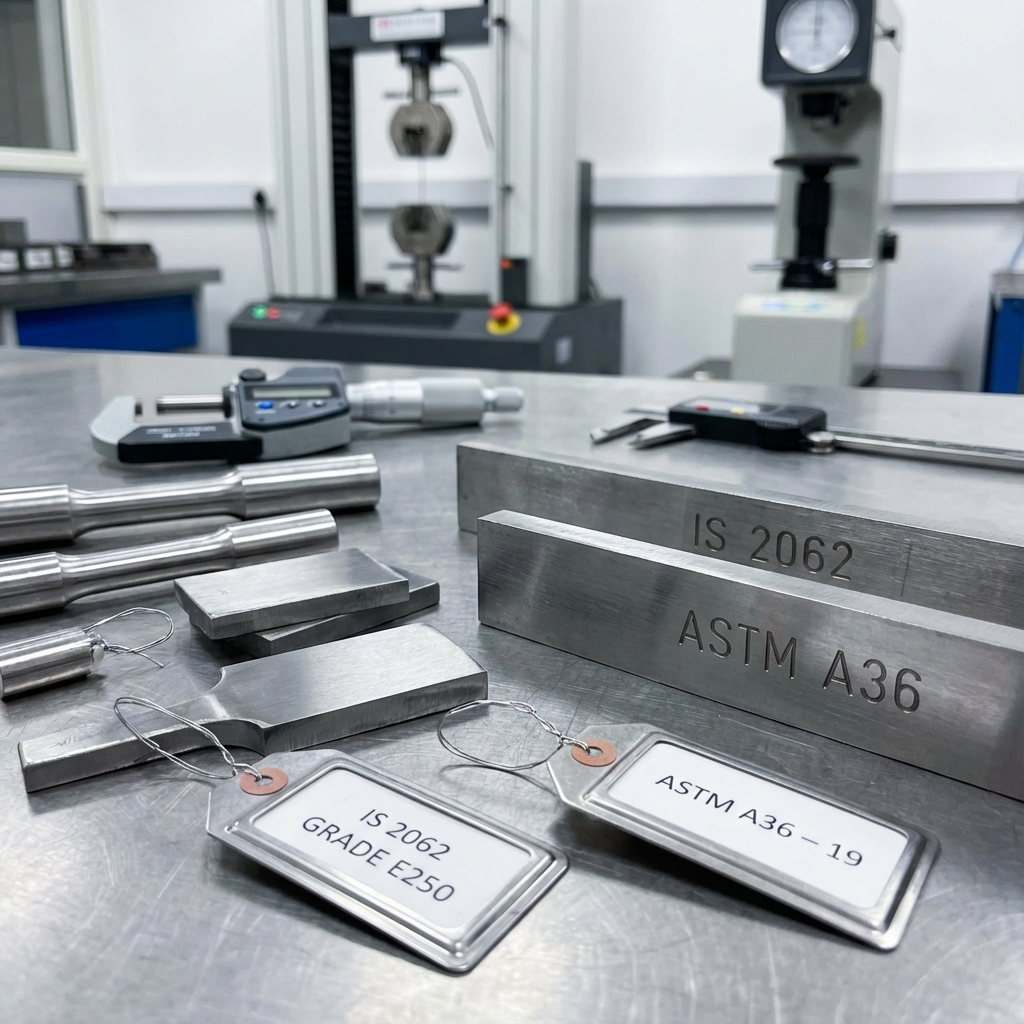
IS 2062 and ASTM A36 are the most commonly specified grades for general structural applications in India and globally. They are widely considered equivalent, though subtle differences exist.
| Property | IS 2062 E250A | ASTM A36 |
|---|---|---|
| Yield Strength | 250 MPa minimum | 250 MPa (36 ksi) minimum |
| Tensile Strength | 410-540 MPa | 400-550 MPa (58-80 ksi) |
| Elongation | 23% minimum | 20-23% minimum |
| Carbon (C) | 0.23% max | 0.25-0.29% max |
| Manganese (Mn) | 1.50% max | 1.03% typical |
| Silicon (Si) | 0.40% max | 0.28-0.40% max |
| Sulfur (S) | 0.050% max | 0.050% max |
| Phosphorus (P) | 0.050% max | 0.040% max |
| Primary Applications | Bridges, buildings, industrial structures | Construction, bridges, general fabrication |
Key Takeaway: IS 2062 E250A and ASTM A36 are functionally equivalent for most structural applications, with nearly identical mechanical properties. For projects in India, IS 2062 plates are typically 15-25% more cost-effective due to local production. However, export projects or those requiring international certifications may mandate ASTM A36.
IS 2062 Grade Variants Explained
IS 2062 offers multiple grades tailored to different applications and service conditions:
Grade A (Fe 410W A)
- Basic structural grade for non-critical applications
- No impact testing requirement
- Suitable for normal loading conditions
- Most cost-effective option for general construction
Grade B (Fe 410W B)
- Medium-strength for general construction and fabrication
- Impact testing required at room temperature (27J minimum)
- Intended for service temperatures not below 0°C
- Common choice for industrial structural work
Grade C (Fe 410W C)
- Low-temperature applications (guaranteed impact properties at -20°C)
- Critical uses where brittle fracture risks must be mitigated
- Stricter impurity controls (lower S and P content)
- Mandatory for cold regions and seismic zones
High-Strength Standards Comparison
For applications requiring strength beyond mild steel grades, both systems offer high-strength specifications:
| Application | IS Standard | ASTM Equivalent | Yield Strength |
|---|---|---|---|
| Structural steel - basic | IS 2062 E250 | ASTM A36 | 250 MPa |
| High-strength structural | IS 2062 E350 | ASTM A572 Gr 50 | 345-350 MPa |
| Wide-flange beams | IS 2062 E450 | ASTM A992 | 345 MPa min |
| Reinforcement bars | IS 1786 Fe 500 | ASTM A615 Gr 60 | 415-500 MPa |
| Anchor bolts - standard | IS 5624 | ASTM F1554 Gr 36 | 248-250 MPa |
| High-strength bolting | Various IS specs | ASTM A193 B7 | 720 MPa (105 ksi) |
Selection Criteria: When to Use IS vs ASTM
Choose IS Standards When:
- Domestic Indian Projects: Projects executed entirely within India with Indian design engineers and contractors
- Cost Optimization: Budget-sensitive projects where locally produced IS 2062 offers 15-25% cost savings over ASTM A36
- Faster Procurement: Local steel availability reduces lead times from 4-6 weeks (imported ASTM) to 1-2 weeks
- Regulatory Compliance: Government projects mandating IS codes (many state PWDs require IS 800 design and IS 2062 material)
- Local Testing Labs: NABL-accredited Indian labs more familiar with IS testing procedures
- Climate Requirements: IS 2062 Grade B and C variants specifically address Indian climate conditions
Choose ASTM Standards When:
- Export Projects: Equipment or structures destined for international markets
- Multinational Specifications: Projects designed by international engineering firms requiring ASTM compliance
- Specialized Applications: High-temperature, high-pressure vessels requiring ASTM A193 B7 or similar grades not covered by IS
- International Financing: Projects funded by World Bank, ADB, or foreign lenders often require ASTM specifications
- Third-Party Certification: Insurance or quality requirements mandating international standards recognition
- Supply Chain Integration: Projects part of global supply chains where ASTM ensures universal acceptance
Critical Differences to Understand
1. Testing and Documentation
IS Standards: Typically require test certificates per IS 1730 (Type 3.1 for structural steel). Mill test certificates (MTCs) from Indian steel mills are standard practice.
ASTM Standards: Often require more comprehensive documentation including chemical composition analysis, mechanical property verification, and heat number traceability. EN 10204 3.1 certificates common for international projects.
2. Dimensional Tolerances
IS 808 and ASTM dimensional specifications have minor differences in tolerances for sections, which can affect fit-up during fabrication. Always verify dimensional standards match design requirements.
3. Impact Testing Requirements
IS 2062 explicitly defines impact testing requirements based on grades (A, B, C). ASTM A36 does not mandate impact testing unless specified by the purchaser—this is a critical difference for seismic or low-temperature applications.
Engineering Best Practice
For critical structural applications in seismic zones (Zone III, IV, V in India), always specify IS 2062 Grade C or ASTM A36 with supplementary Charpy V-notch impact testing at the design service temperature. This ensures adequate toughness and reduces brittle fracture risk during earthquake loading.
Cost and Procurement Considerations
Typical Cost Differential (Indian Market)
- IS 2062 E250: Baseline cost (₹48,000-52,000 per MT typical)
- ASTM A36 (imported): 20-30% premium over IS 2062 due to import duties, freight, certification
- ASTM A36 (from Indian mills): 10-15% premium (limited availability, certification costs)
- High-strength grades (IS E350/ASTM A572): 15-20% premium over base grades
- Specialty alloy grades (ASTM A193 B7): 100-150% premium over structural grades
Lead Times
- IS 2062 (domestic): 1-2 weeks for standard sections, 3-4 weeks for custom fabrication
- ASTM (imported): 6-8 weeks typical (including documentation, shipping, customs clearance)
- ASTM (Indian production): 4-6 weeks (limited mill capacity for ASTM certification)
International Equivalents Reference
For multinational projects, understanding cross-standard equivalencies is crucial:
| IS Standard | ASTM | EN (Europe) | JIS (Japan) | GB (China) |
|---|---|---|---|---|
| IS 2062 E250 | A36 | S235JR | SS400 | Q235B |
| IS 2062 E350 | A572 Gr 50 | S355J2 | SM490 | Q345B |
Important Note: While these grades are considered equivalent for general structural use, minor differences in chemical composition, mechanical properties, and testing requirements exist. Always review detailed specifications for critical applications and consult with a qualified materials engineer when substituting grades across standards.
Quality Assurance and Testing
IS 2062 Testing Requirements
- Tensile test (yield strength, tensile strength, elongation)
- Bend test (for plates and sections)
- Impact test (for Grades B and C - Charpy V-notch)
- Chemical composition analysis
- Dimensional verification
- Surface quality inspection
ASTM A36 Testing Requirements
- Tensile test per ASTM A370
- Chemical composition analysis
- Impact testing (if specified by purchaser)
- Dimensional tolerances per ASTM A6
- Heat number traceability
- Third-party inspection (if contractually required)
How Ayask Steel Navigates IS and ASTM Standards
At Ayask Steel, we manufacture precision components to both IS and ASTM specifications, providing our customers with flexibility to meet project requirements regardless of the governing standard.
Our Capabilities:
- Dual certification: Foundation bolts and fabrications to IS 2062/IS 5624 and ASTM A36/F1554
- Complete material traceability with heat numbers for ASTM compliance
- In-house testing: Tensile, hardness, chemical composition, dimensional verification
- Third-party testing coordination with NABL-accredited labs for international projects
- Material equivalency guidance: Helping project teams navigate IS-ASTM substitutions
- Documentation expertise: MTCs per IS 1730, EN 10204 3.1, ASTM requirements
- Procurement optimization: Advising on cost-effective material selection (IS vs ASTM)
Material Sourcing:
- IS 2062 from leading Indian mills (SAIL, Tata Steel, JSW)
- ASTM A36 from certified Indian producers and international suppliers
- High-strength alloy grades (ASTM A193 B7, A320 L7) from approved sources
- Complete chemical and mechanical property verification before fabrication
Need Help Selecting Between IS and ASTM?
Contact Ayask Steel at +91 98338 33990 or email info@ayasksteel.com. Our materials engineering team can review your project specifications, recommend appropriate standards, suggest equivalent grades, and provide material test certificates meeting your exact requirements—whether IS, ASTM, or international standards.
Common Pitfalls to Avoid
❌ Don't mix standards inappropriately:
- Using ASTM bolts with IS 2062 structure without engineering approval
- Assuming exact equivalence without reviewing chemical composition differences
- Specifying ASTM for domestic projects where IS offers equal performance at lower cost
✅ Do follow best practices:
- Specify one standard consistently throughout a project for simplicity
- Obtain material test certificates for all structural steel
- Verify equivalencies with qualified materials engineer for critical applications
- Consider total cost (material + certification + lead time) when choosing standards
Frequently Asked Questions
Can I use IS 2062 E250 instead of ASTM A36?
What does 'E250' mean in IS 2062?
Why is ASTM A36 more expensive in India?
What is the difference between Grade A, B, and C in IS 2062?
Is IS 1786 the same as ASTM A615?
Understanding the nuances between IS and ASTM steel standards empowers informed decision-making that balances technical requirements, regulatory compliance, cost constraints, and procurement realities. Whether your project demands the cost-effectiveness of locally produced IS 2062 or the international recognition of ASTM A36, selecting the appropriate standard—and ensuring rigorous quality control—is fundamental to long-term structural integrity and project success.
At Ayask Steel, we navigate both standards daily, providing our customers with precision-manufactured components that meet exacting specifications regardless of the governing code. Our 40+ years of experience ensures you receive the right material, properly certified, on time, every time.