How Steel Density and Material Grades Impact Weight Calculations
The Ayask Steel Engineering Team writes for plant buyers, project engineers, and procurement teams sourcing custom steel components as per drawing. Our perspective comes from 40+ years of manufacturing rolling mill components, replacement parts, and fabricated-and-machined assemblies where fit, function, delivery, and documentation all matter.
- 40+ years of continuous manufacturing operations
- Experience with replacement parts, shutdown support, and project-based industrial manufacturing
- Built-to-print fabrication and machining for OEMs, EPCs, steel plants, and maintenance teams
Weight formulas are only as accurate as the density value behind them. In fabrication, procurement, and dispatch planning, the wrong material grade can quietly distort your numbers before the first cut is made.
When engineers calculate steel weight, the headline formula is simple: Weight = Volume × Density. The part that gets oversimplified is the density constant. Many workshops default to 7,850 kg/m³ for carbon steel, which is a practical baseline, but stainless grades, high-speed tool steels, and cast irons do not all use the same number. If your BOM, freight plan, or crane calculation is based on the wrong density, the error carries through the whole job.
The Core Rule: Weight = Volume × Density
Density is mass per unit volume. For ferrous materials, density changes mainly with chemistry: nickel, molybdenum, tungsten, cobalt, graphite content, and other alloying additions move the final number up or down. Section size stays the same, but the mass of the same geometry changes with the grade.
Master Formula
Weight (kg) = Volume (m³) × Density (kg/m³)
Always use the density published for the actual grade when a project is material-sensitive.
Density Reference Chart for Common Engineering Grades
The table below is designed for estimation work. It combines standard calculation practice for carbon steel with published producer data for stainless and tool steel examples.
| Material / Grade | Density (kg/m³) | Typical Use in Weight Calculations |
|---|---|---|
| Carbon / structural steel | 7,850 | Default planning value for plates, bars, sections, and anchor components |
| Stainless steel 304 | 7,900 | Use a published mill value for 304 sheet, plate, tube, or bar calculations |
| Stainless steel 316L | 7,900 to 8,000 | Verify the producer datasheet before quoting or dispatch planning |
| High-speed tool steel (cobalt-bearing example) | 8,040 | Useful when tooling bars or wear parts are estimated by volume |
| Gray cast iron | ~7,200 | Comparison material only; do not use steel constants for cast iron parts |
Important note on published values
Producer datasheets do not always round the same way. For example, published 316L references can appear as 7.9 kg/dm³ or 8.0 kg/dm³ depending on the manufacturer and document. That difference looks small, but on a 10-ton lot it can shift the theoretical estimate by about 100 kg. The safest practice is to pick one published value for the approved material source and use it consistently through quoting, BOMs, and logistics.
Worked Example: Same Plate, Different Grades
Consider a plate with the following nominal dimensions:
- Length: 2.0 m
- Width: 1.0 m
- Thickness: 10 mm = 0.010 m
Step 1: Calculate volume
Volume = 2.0 × 1.0 × 0.010 = 0.020 m³
Step 2: Apply density
- Carbon steel at 7,850 kg/m³: 157.0 kg
- 304 stainless at 7,900 kg/m³: 158.0 kg
- 316L stainless at 8,000 kg/m³: 160.0 kg
- High-speed tool steel at 8,040 kg/m³: 160.8 kg
The geometry never changed, but the estimated weight did. This is why density matters for dispatch notes, procurement comparisons, and machine load calculations, especially when a job moves from carbon steel to stainless or tool steel.
Quick Adjustment Formulas for Shop Use
Once you know the density, you can adapt common workshop formulas instead of rebuilding the math from scratch.
Round bar weight per meter
For carbon steel, the common shortcut is:
kg/m = D² × 0.006165
For another grade, multiply by Density / 7,850.
Plate weight
If length and width are in meters and thickness is in millimeters:
Weight (kg) = L × W × T × Density / 1000
This avoids mixing unit systems and makes grade changes easy to audit.
Use Grade-Specific Density in One Place
Our weight calculator is most useful when the density constant matches the approved material grade. That keeps procurement, fabrication, and transport numbers aligned.
What Usually Changes Actual Weight More Than Density
Density is only one part of the estimate. In real orders, these factors often create larger deviations than the chemistry itself:
- Rolling tolerances: nominal thickness and actual thickness are not always identical.
- Machining allowance: raw bars ordered for turning may be intentionally oversized.
- Cutouts and holes: net weight can be far lower than gross plate weight.
- Coatings and attachments: galvanizing, weld metal, liners, and hardware all add mass outside the base formula.
If you need those adjustments next, see our guides on steel plate weight calculation, round bar weight formulas, and theoretical vs actual steel weight.
Practical Rule for RFQs, BOMs, and Dispatch Notes
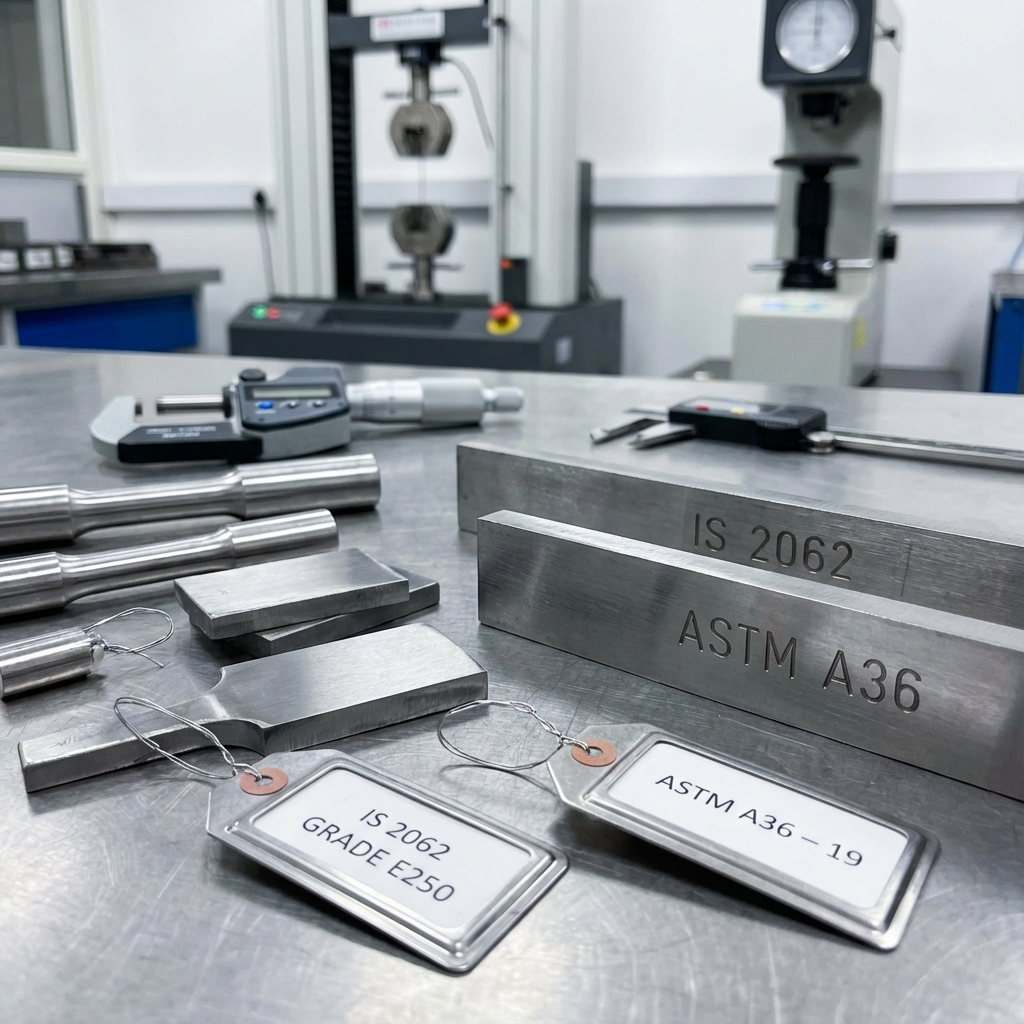
For standard structural work, 7,850 kg/m³ remains a practical carbon-steel baseline. For stainless, tool steel, or any customer-approved alloy, use the published mill or supplier datasheet. If the job is certification-sensitive, align your density value with the same source package used for the grade and material standard. That keeps your quote, production estimate, and dispatch paperwork internally consistent.
Frequently Asked Questions
What density should I use for mild steel or structural steel weight calculation?
Does stainless steel always weigh more than carbon steel?
Why should I verify the density from the material supplier?
Is cast iron the same as steel for weight calculation?
Does heat treatment change the density enough to update the BOM formula?
Conclusion
The most reliable steel weight calculation is not the one with the fanciest formula. It is the one that uses the right density for the approved material grade, the right nominal dimensions, and the right assumptions about manufacturing variation. When the project is material-sensitive, treat density as a specification input, not a background constant.
Ayask Steel manufactures custom industrial components as per drawing, including fabricated and machined parts where material grade, weight, and dimensional accuracy all influence the final result. When your job depends on correct theoretical weight before production starts, disciplined assumptions matter.