Industrial Foundation Bolts: Types, Grades & Standard Guide
The Ayask Steel Engineering Team writes for plant buyers, project engineers, and procurement teams sourcing custom steel components as per drawing. Our perspective comes from 40+ years of manufacturing rolling mill components, replacement parts, and fabricated-and-machined assemblies where fit, function, delivery, and documentation all matter.
- 40+ years of continuous manufacturing operations
- Experience with replacement parts, shutdown support, and project-based industrial manufacturing
- Built-to-print fabrication and machining for OEMs, EPCs, steel plants, and maintenance teams
Foundation bolts—also known as anchor bolts or holding-down bolts—are the critical, often invisible link between heavy industrial equipment and concrete foundations. These precision-engineered fasteners ensure structural stability, operational safety, and decades of reliable performance in power plants, steel mills, chemical facilities, and infrastructure projects worldwide. With over 40 years of expertise in precision steel fabrication, Ayask Steel has designed and manufactured foundation bolts for thousands of critical industrial applications. This ultimate guide distills our engineering knowledge into actionable insights for your next project.
What Are Foundation Bolts?
Foundation bolts are specialized fasteners designed to connect structural and non-structural elements to concrete foundations. Unlike standard bolts, they must resist significant tensile, shear, and combined loads while maintaining stability under dynamic conditions—including vibration, thermal cycling, and seismic activity.
These bolts are either embedded in concrete during the pouring process (cast-in-place anchors) or installed post-pour using specialized anchoring systems. Their primary function is to transfer loads from equipment, machinery, or structural elements into the foundation, preventing displacement, uplift, and vibration-induced movement.
Critical Engineering Principle
Foundation bolts must account for not just static loads but also thermal expansion (up to 0.012 mm per meter per °C in steel), vibration (particularly in rotating equipment at 1500-3000 RPM), seismic activity, and operational stresses. Proper material selection, embedment design, and installation are non-negotiable for operational safety.
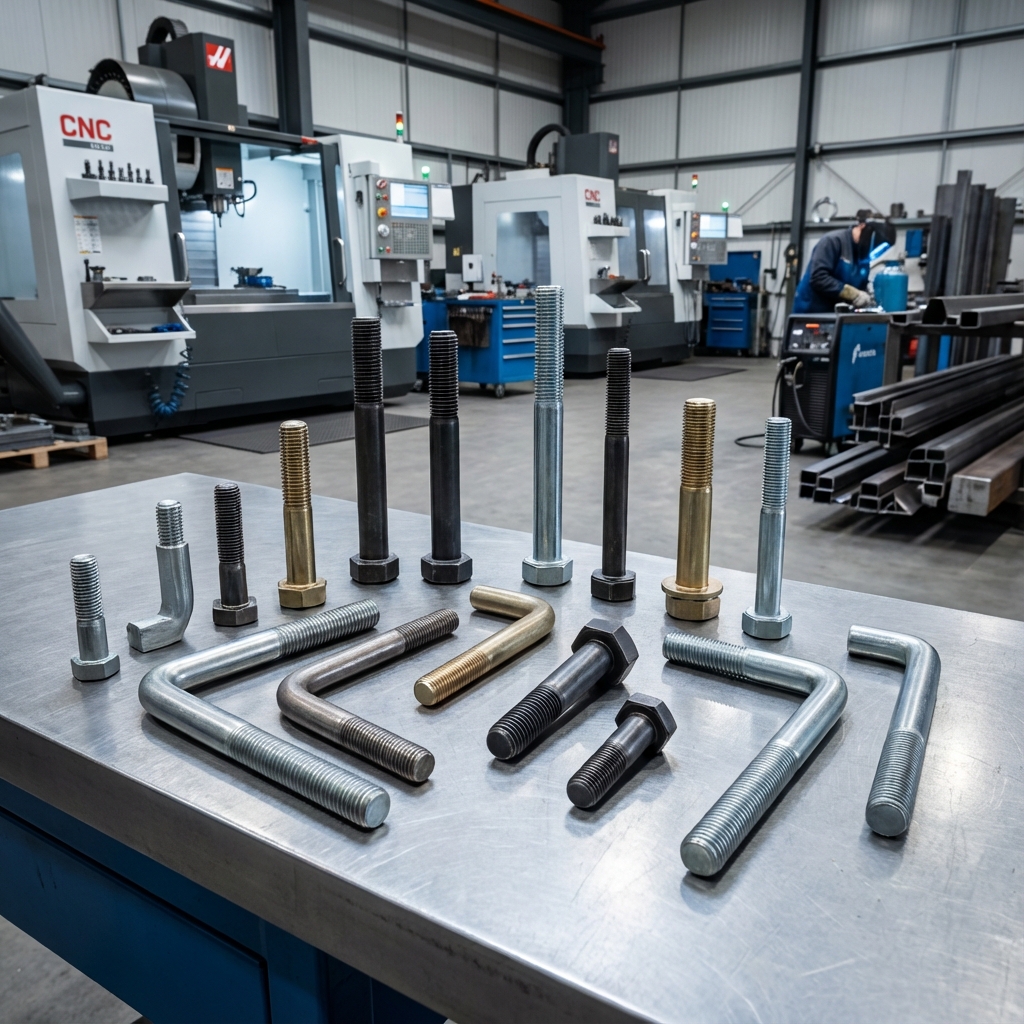
Comprehensive Types of Foundation Bolts
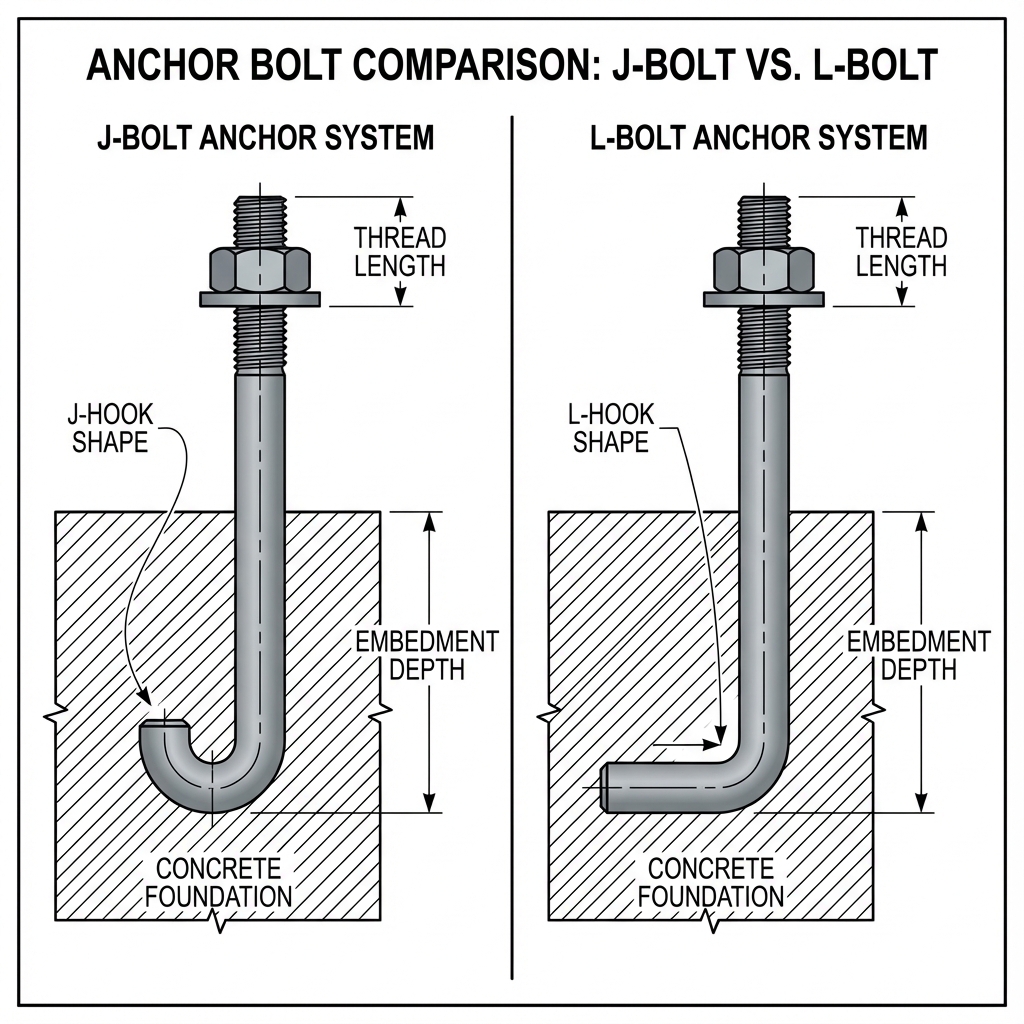
Understanding the different types of foundation bolts and their specific applications is essential for project success. Each type offers distinct mechanical advantages based on load requirements, installation constraints, and operating conditions. Learn more about choosing between J-bolts and L-bolts.
1. J-Bolts (Hooked Anchor Bolts)
J-bolts feature a characteristic J-shaped hook at the bottom end and threads at the top. The hook provides mechanical resistance against pullout forces by interlocking with the concrete matrix.
Best Applications:
- Light to medium-duty equipment anchoring (up to 50 kN tensile loads)
- Structural steel column bases and beam connections
- Machinery with moderate vibration (pumps, compressors)
- Applications requiring precise bolt positioning during concrete pour
Advantages:
- Simple, cost-effective installation during concrete pour
- Good pullout resistance from mechanical hook engagement
- Available in standard sizes (M12 to M64) and custom configurations
- Minimal concrete breakout risk in properly designed foundations
Limitations:
- Lower pullout strength compared to L-bolts (approximately 60-70% for equivalent size)
- Not ideal for high-tension applications exceeding 75 kN
- Hook geometry can make post-pour positioning adjustments difficult
2. L-Bolts (Bent Anchor Bolts)
L-bolts have a 90-degree bend at the bottom, creating an "L" shape that provides superior anchorage through greater embedment depth and mechanical interlocking with concrete.
Best Applications:
- Heavy-duty industrial equipment (turbines, generators, crushers)
- High-tension applications up to 200+ kN
- Seismic zones (Zone III, IV, V) requiring enhanced anchorage
- Power plant turbine foundations and large rotating machinery
- Large pump and compressor installations with dynamic loads
Advantages:
- Superior pullout resistance—up to 40% higher than equivalent J-bolts
- Excellent performance under combined shear and tension loads
- Better stability under seismic and cyclic loading conditions
- Larger bearing area distributes stress more effectively
3. Straight Anchor Bolts with Plates
These consist of straight threaded rods with anchor plates (typically 150mm x 150mm to 300mm x 300mm) welded at the bottom. The plate distributes loads over a larger concrete area, reducing bearing stress.
Advantages:
- Excellent load distribution—bearing stress reduced by 60-80% compared to headed bolts
- Easy elevation adjustment (±25mm typical) before concrete sets
- Superior shear resistance up to 150 kN for M36 bolts
- Can be custom fabricated with varying plate sizes for specific load conditions
4. Double-End Anchor Bolts
Threaded on both ends with a smooth central shaft, these bolts are partially embedded in concrete and project above the surface for equipment attachment.
Best Applications:
- Adjustable mounting systems requiring vertical positioning precision
- Equipment subject to frequent replacement or maintenance cycles
- Applications requiring threaded connection on both concrete and equipment sides
5. Swedge Anchor Bolts
Characterized by serrated indentations on the shank, swedge bolts provide enhanced mechanical grip in concrete through increased surface friction. Often used for bridge piers, highway structures, and heavy structural steel connections.
Material Grades and Specifications
Material selection directly impacts performance, durability, corrosion resistance, and long-term safety. Here's a comprehensive breakdown of commonly specified grades. For a detailed comparison, see our guide on IS vs ASTM steel standards.
| Grade | Yield Strength | Tensile Strength | Applications |
|---|---|---|---|
| IS 2062 E250 | 250 MPa | 410-540 MPa | General structural steel, most industrial applications |
| ASTM A36 | 250 MPa (36 ksi) | 400-550 MPa | International equivalent to IS 2062, widely used globally |
| ASTM F1554 Grade 36 | 248 MPa | 400-550 MPa | Anchor bolts for structural applications |
| ASTM F1554 Grade 55 | 380 MPa | 515 MPa min | Medium-strength anchor bolts, seismic zones |
| ASTM F1554 Grade 105 | 724 MPa | 860 MPa min | High-strength applications, weldable with precautions |
| ASTM A193 B7 | 720 MPa (105 ksi) | 860 MPa (125 ksi) | High-temperature (up to 700°F), high-pressure service |
| ASTM A320 L7 | 725 MPa | 860 MPa | Low-temperature service down to -46°C |
Material Selection Critical Tip: Always verify that your material grade meets or exceeds design specifications. For critical applications in power plants, petrochemical facilities, or nuclear installations, request certified material test certificates (MTCs) with complete chemical composition and mechanical property documentation. Ayask Steel provides full traceability with heat numbers for every batch.
Critical Engineering Calculations
Embedment Depth Requirements
Proper embedment depth is the single most critical factor in anchor bolt performance. Insufficient embedment leads to premature failure, while excessive depth increases material and installation costs unnecessarily.
General Guidelines:
- Minimum Depth: 4 inches (100mm) for basic anchorage
- Structural Applications: Minimum 7 inches (178mm), per IRC requirements
- Heavy-Duty Rule: 10× bolt diameter for high-load applications
- Seismic Zones: 12-15× bolt diameter in Zone IV and V
- Power Plant Equipment: Often 15-20× diameter with engineered embedment design
Example Calculation:
For an M48 anchor bolt in a seismic zone supporting a 150 kN tensile load:
- Bolt diameter: 48mm
- Required embedment: 15 × 48mm = 720mm minimum
- Design embedment: 800mm (including safety factor)
- Concrete strength required: Minimum 30 MPa (M30 grade)
Spacing and Edge Distance
Proper spacing prevents concrete breakout failure and ensures uniform load distribution across the foundation.
IRC and ACI 318 Requirements:
- Maximum Spacing: 6 feet (1829mm) on center for structural plates
- End Distance: Within 12 inches (305mm) from plate section ends
- Minimum Edge Distance: 10-12× bolt diameter from concrete edge
- Seismic Zones: Reduce spacing to 4 feet (1219mm) or less
- Minimum Bolts: At least 2 bolts per sill plate section
Critical Industrial Applications
Power Generation Facilities
Foundation bolts in power plants must withstand extreme conditions: continuous vibration (1500-3000 RPM for turbines), thermal cycling (ambient to 550°C in some locations), and massive static loads.
Turbine Foundation Specifications:
- Typical loads: 100-500 kN per bolt
- Material: ASTM A193 B7 or F1554 Grade 105
- Surface treatment: Hot-dip galvanizing (minimum 85 microns)
- Positioning tolerance: ±2mm (extremely critical for turbine alignment)
- Documentation: 100% material certificates, third-party testing
Steel Mills and Heavy Industry
Steel mills subject foundation bolts to perhaps the harshest conditions: continuous vibration, shock loads from rolling mills, high temperatures (up to 200°C ambient), dust, and chemical exposure.
Typical Steel Mill Applications:
- Recoiler and uncoiler foundations (4-6 meter long bolts common)
- Rolling mill equipment (M64-M100 diameter bolts)
- Furnace and ladle support structures (heat-resistant grades)
- Overhead crane rail foundations (fatigue-resistant designs)
Installation Best Practices
Pre-Installation Planning
- Review structural drawings for precise bolt positions and embedment depths
- Verify concrete grade meets minimum strength requirements (typically M25-M40)
- Prepare accurate templates (steel or plywood with ±1mm tolerance)
- Coordinate civil and mechanical installation teams
- Conduct soil analysis for foundations supporting very heavy equipment
During Concrete Pour
- Use rigid templates and wire bolts directly to rebar
- Ensure bolt verticality within 1:100 tolerance (checked with plumb bob or laser level)
- Protect threads with plastic sleeves or grease to prevent concrete contamination
- Verify embedment depth meets specifications before concrete sets
- Avoid vibrator contact with bolts during concrete consolidation
Post-Installation Verification
- Inspect bolt projection and alignment (tolerance typically ±5mm)
- Conduct pull-out tests if specified (typically 1.25× design load)
- Document final positions for as-built drawings
- Apply corrosion protection to exposed threads if not galvanized
- Verify torque requirements for critical applications per ASTM F1554
Common Installation Errors to Avoid
- 1. Insufficient Embedment: Always meet minimum 15-20× diameter for critical applications
- 2. Thread Contamination: Concrete in threads prevents proper nut seating and reduces clamping force by 30-40%
- 3. Inadequate Spacing: Maintain minimum edge distance of 10× diameter to prevent concrete breakout
- 4. Poor Template Quality: Use rigid steel templates, not flexible materials that deflect during concrete pour
Quality Standards and Testing
Foundation bolts for critical applications must comply with relevant national and international standards:
| IS 5624 | Specification for foundation bolts (Indian Standard) |
| ASTM F1554 | Standard specification for anchor bolts, steel, Grades 36, 55, and 105 |
| ACI 318 | Building code requirements for structural concrete |
| ISO 898-1 | Mechanical properties of fasteners made of carbon steel and alloy steel |
| BS 4604 | Specification for high-strength friction grip bolts |
Required Testing
Material Testing:
- Chemical composition analysis (Spectroscopy)
- Tensile strength testing per ASTM A370
- Hardness testing (Rockwell or Brinell)
- Impact testing for low-temperature applications (Charpy V-notch)
- Coating thickness verification (for galvanized bolts)
Dimensional Inspection:
- Thread pitch and profile verification (go/no-go gauges)
- Length and diameter tolerances (±0.5mm typical)
- Straightness checks (max 0.5mm deviation per meter)
- Surface finish inspection (visual and Ra measurement)
Corrosion Protection Strategies
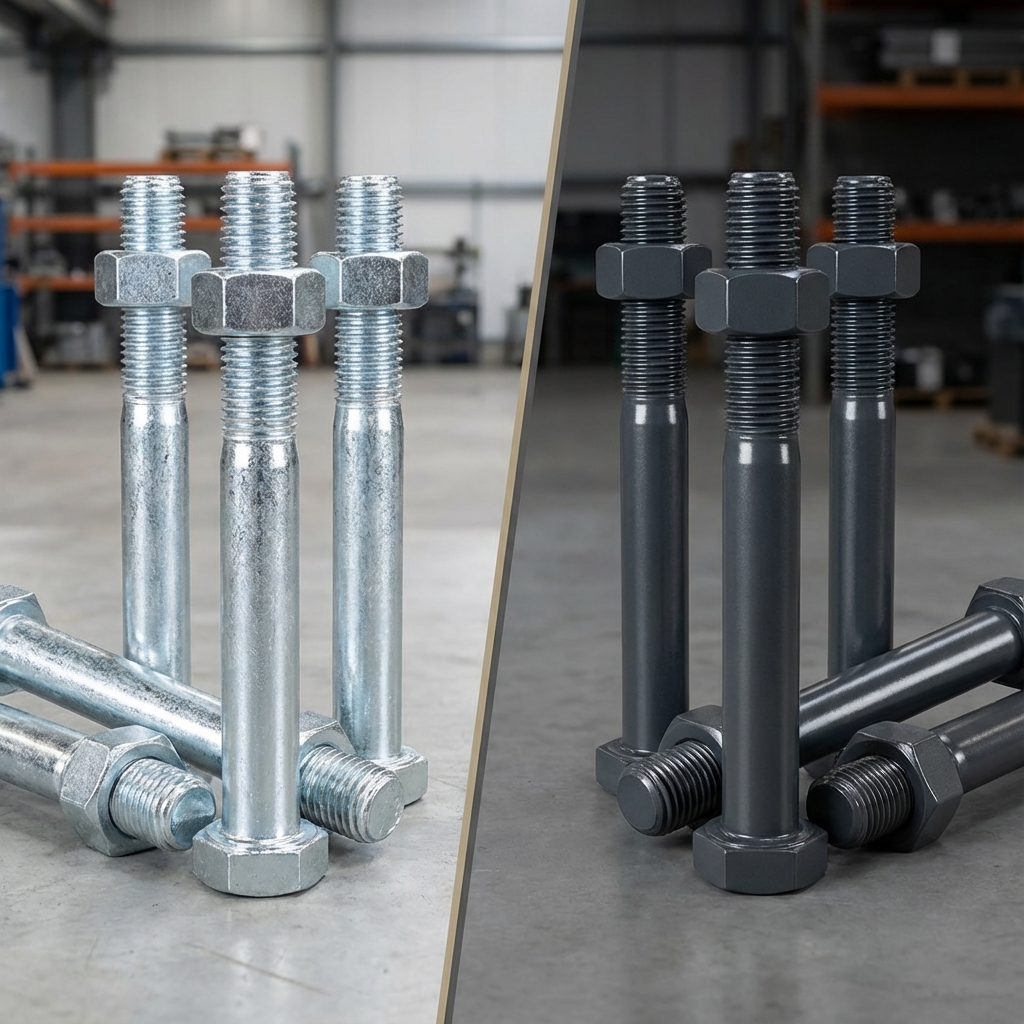
Hot-Dip Galvanizing
The gold standard for long-term corrosion protection. Provides 50+ years protection in moderate environments, 25-35 years in coastal/industrial atmospheres.
- Minimum coating thickness: 85 microns per ASTM A153
- Provides both barrier and cathodic protection
- Self-healing properties protect against minor damage
- Cost-effective for large batches (50+ bolts)
Epoxy and Powder Coatings
Excellent for chemical environments (refineries, chemical plants). Provides superior resistance to acids, alkalis, and solvents.
Stainless Steel
For the most demanding environments: marine applications, wastewater treatment, food processing. Common grades: SS 304 (general purpose), SS 316 (high chloride resistance), SS 316L (welding applications).
Why Choose Ayask Steel for Foundation Bolts
At Ayask Steel, we understand that foundation bolts are precision-engineered critical components, not commodity fasteners. Our 40+ years of experience in serving power plants, steel mills, and heavy industries gives us unmatched expertise in designing and manufacturing anchor bolts for the most demanding applications.
Our Capabilities:
- Custom fabrication from M12 to M100+ diameter, lengths up to 6 meters
- All material grades: IS 2062 to ASTM A193 B7, stainless steel, and exotic alloys
- In-house heat treatment facilities (hardening, tempering, stress relieving)
- Complete material traceability with heat numbers and MTCs
- Hot-dip galvanizing, epoxy coating, and specialty surface treatments
- Design assistance and engineering support for complex applications
- Rapid prototyping for custom anchor assemblies
Quality Assurance:
- 100% dimensional inspection with CMM verification for critical dimensions
- Material test certificates for every batch
- Third-party testing coordination (NABL accredited labs)
- Comprehensive documentation package with as-built records
- ISO 9001:2015 certified quality management system
On-Time Delivery:
We've built our reputation on meeting critical shutdown schedules in power plants and steel mills. Our production planning ensures your foundation bolts arrive when you need them—coordinated with your civil construction timeline, not when it's convenient for us.
Getting Started with Your Project
Foundation bolt selection involves balancing technical requirements, cost constraints, timeline pressures, and long-term performance expectations. Here's how we can help:
Our Process:
- Share Requirements: Send drawings, load specifications, material grades, and project timeline
- Engineering Review: Our team reviews for manufacturability and suggests design optimizations
- Material Recommendation: We recommend appropriate grades based on operating conditions
- Quote and Timeline: Detailed pricing with realistic delivery schedules (typically 3-6 weeks)
- Production: Manufacturing with full quality documentation and progress updates
- Delivery: Packaged and delivered to your site, ready for installation
Frequently Asked Questions
What are foundation bolts and why are they important?
What's the difference between J-bolts and L-bolts?
What material grades should I use for foundation bolts?
How deep should foundation bolts be embedded in concrete?
What corrosion protection is best for foundation bolts?
Can foundation bolts be installed after concrete is poured?
What tolerance standards apply to foundation bolt installation?
How do I calculate the required number and size of foundation bolts?
Ready to Discuss Your Foundation Bolt Requirements?
Call us at +91 98338 33990 or email info@ayasksteel.com to discuss your project with our engineering team. Whether you need 10 anchor bolts for a small project or 500+ assemblies for a power plant expansion, we're here to ensure your foundation bolts meet every specification and deadline.
Foundation bolts may seem like simple components, but the engineering precision required for critical industrial applications is anything but simple. With proper material selection, accurate fabrication to tolerances of ±0.5mm, and expert installation following ACI 318 and ASTM F1554 guidelines, foundation bolts provide decades of reliable, maintenance-free service.
Whether you're building a new thermal power plant, expanding a steel mill, or maintaining existing infrastructure, partnering with an experienced manufacturer like Ayask Steel ensures your foundation bolts meet the highest standards of quality, precision, and long-term reliability.