J-Bolts vs L-Bolts: Engineering Comparison & Selection Guide
The Ayask Technical Team writes about steel grades, corrosion protection, and specification choices for foundation and plant components. Their focus is helping engineers and procurement teams choose materials, coatings, and documentation requirements that match service environment, compliance needs, and long-term reliability.
- Works across IS, ASTM, BS, and EN material standards
- Guidance on hot-dip galvanizing, epoxy, duplex, and stainless options
- Supports coastal, chemical, and heavy industrial service conditions
Choosing between J-bolts and L-bolts is one of the most critical decisions in foundation design—one that directly impacts structural integrity, installation complexity, long-term performance, and project costs. While both anchor types serve to secure structural elements to concrete foundations, their distinct geometries, load capacities, and mechanical behaviors make each ideal for specific applications. This comprehensive guide provides the engineering insights you need to select the optimal anchor bolt for your project.
Understanding the Fundamental Difference
The primary distinction between J-bolts and L-bolts lies in their embedded end geometry, which fundamentally affects how they resist loads and interact with concrete:
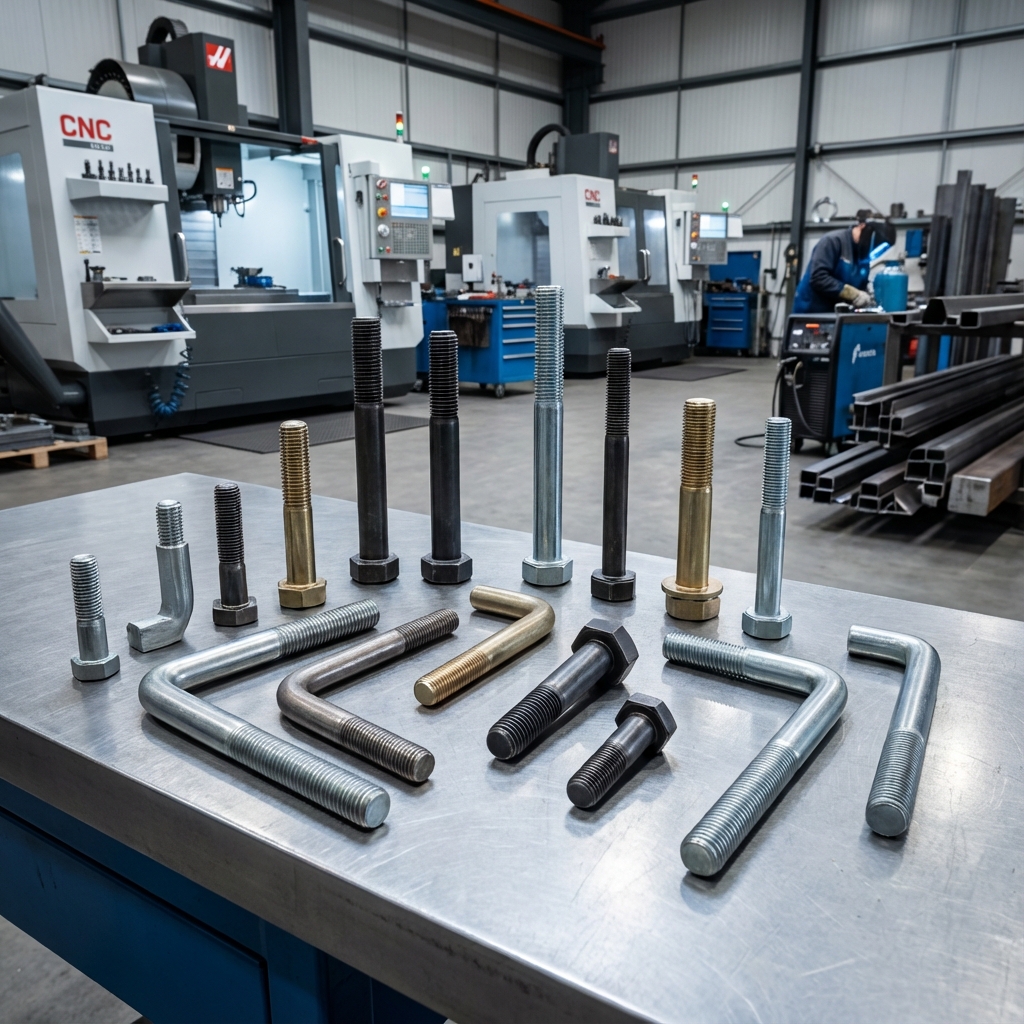
- J-Bolts: Feature a curved, hook-shaped end resembling the letter "J". The hook provides mechanical interlock by engaging concrete around and beneath the curve.
- L-Bolts: Have a 90-degree bend forming an "L" shape, creating a perpendicular leg that bears against concrete for anchorage.
This geometric difference translates directly into variations in pullout resistance, installation requirements, load distribution patterns, and suitability for different structural applications.
Detailed Technical Comparison
| Feature | J-Bolts | L-Bolts |
|---|---|---|
| Shape | Curved hook (J-shaped) | 90-degree bend (L-shaped) |
| Primary Load Resistance | Excellent vertical pullout, good shear | Superior deep-embedment pullout, excellent compression |
| Pullout Resistance | Very Good (60-75% efficiency vs. L-bolt) | Excellent (40% higher than J-bolt equivalent) |
| Typical Load Capacity | Medium to heavy (up to 75 kN tensile) | Heavy-duty (up to 200+ kN tensile) |
| Installation Timing | Cast-in-place (before concrete pour) | Cast-in-place or post-installed |
| Installation Complexity | Moderate (requires hook orientation) | Simpler for standard applications |
| Embedment Depth | 20-25× diameter recommended | Minimum 10× diameter for heavy-duty |
| Seismic Performance | Good (requires proper hook orientation) | Excellent (superior for seismic zones) |
| Cost | Moderate | Lower (simpler geometry) |
| Adjustability | Some vertical adjustment possible | Easy removal and repositioning |
J-Bolts: In-Depth Analysis
How J-Bolts Work
J-bolts achieve their holding power through a combination of mechanical interlock and concrete bearing. The curved hook wraps around reinforcing steel (rebar) or embeds into the concrete mass, creating resistance against upward and lateral movement. The extended hook geometry distributes tensile loads over a larger concrete volume, reducing localized stress concentrations.
Key Advantages of J-Bolts
- Superior Pullout Resistance: The curved hook provides exceptional resistance to vertical tensile forces—often 20-30% higher than straight bolts of equivalent diameter. This makes them ideal when uplift prevention is critical.
- Excellent Shear Performance: J-bolts effectively resist lateral (shear) forces, making them suitable for applications with significant horizontal loads such as bridge foundations and heavy equipment subject to operational forces.
- Vibration Tolerance: The mechanical hook maintains grip integrity under cyclic loading and vibration, crucial for industrial machinery foundations (compressors, mills, crushers) operating at 1500-3000 RPM.
- Versatile Applications: Suitable for securing foundation plates, sill plates, wood-framed walls, steel column bases, light poles, highway signage, and structural steel connections.
- Can Hook Rebar: When installed around existing rebar patterns, J-bolts gain additional anchorage beyond the concrete bond alone.
Limitations of J-Bolts
- Orientation-Dependent: The hook must be correctly oriented—misalignment reduces effectiveness by up to 40%
- Limited Post-Pour Adjustment: Once concrete sets, repositioning is extremely difficult
- Higher Fabrication Cost: The curved geometry requires additional manufacturing steps compared to L-bolts
- Not Ideal for Extreme Tension: For loads exceeding 75 kN, alternative anchoring methods may be more appropriate
J-Bolt Embedment Formula
Recommended embedment depth: 20-25 × bolt diameter
Example: For an M36 J-bolt
Minimum embedment = 20 × 36mm = 720mm
Recommended embedment = 25 × 36mm = 900mm
L-Bolts: In-Depth Analysis
How L-Bolts Work
L-bolts resist pullout through bearing action—the perpendicular leg pushes against a large area of concrete when subjected to tensile loads. This bearing mechanism distributes forces over a wider concrete zone compared to adhesive or friction-based anchors. The 90-degree geometry allows for deep embedment in thinner foundation sections where J-bolt curves might not fit.
Key Advantages of L-Bolts
- Exceptional Pullout Strength: The 90-degree bearing leg provides up to 40% higher pullout capacity than equivalent J-bolts—critical for heavy turbines, large motors, and high-tension applications.
- Deep Embedment Capability: Allows for effective anchoring in deep foundations (1-2 meters common) with excellent load distribution throughout the embedment zone.
- Superior Seismic Performance: Meets ACI 318 Chapter 17 requirements for Seismic Design Categories C, D, E, and F. The bearing action maintains strength even when concrete cracks under seismic loading.
- Cost-Effective Manufacturing: Simple 90-degree bend requires less fabrication complexity, reducing material and production costs by 15-25% compared to J-bolts.
- Easier Installation: No critical orientation requirement during installation—can be rotated without performance degradation.
- Flexible Adjustment: Some designs allow for bolt removal and repositioning if needed before final equipment installation.
Limitations of L-Bolts
- Requires Adequate Embedment: Minimum 10× diameter embedment mandatory—insufficient depth causes premature failure
- Limited Lateral Load Capacity: While excellent in tension, lateral shear performance is 10-15% lower than J-bolts in some configurations
- Concrete Thickness Dependent: Performance heavily relies on sufficient foundation thickness to accommodate the perpendicular leg
L-Bolt Design Tip: For seismic zones (Zone IV, V), specify L-bolts meeting ASTM F1554 Grade 55 or higher, with embedment depths of 12-15× diameter. Always design assuming cracked concrete conditions per ACI 318 to ensure adequate safety factors.
Application-Specific Recommendations
When to Use J-Bolts
Best Applications:
- Medium-Duty Equipment Foundations: Compressors, pumps, conveyors (loads 25-75 kN)
- Structural Steel Connections: Column base plates, beam-to-foundation connections
- High-Vibration Environments: Industrial plants, mechanical equipment foundations, rotating machinery
- Highway Infrastructure: Light poles, sign structures, guardrail posts, traffic signal bases
- Building Foundations: Sill plates, wood-framed wall anchoring, steel building frames
- Bridges and Overpasses: Bearing anchors, expansion joint supports
When to Use L-Bolts
Best Applications:
- Heavy Industrial Equipment: Turbines, generators, large motors, crushers (loads 75-200+ kN)
- Seismic Zones: Any application in Seismic Design Categories C-F requiring ACI 318 compliance
- Power Plant Installations: Turbine pedestals, generator foundations, boiler supports
- Deep Foundation Applications: Where embedment depths of 1-2 meters are required
- High-Tension Scenarios: Pre-stressed structures, cable-stayed systems, suspension anchor points
- Steel Mill Equipment: Rolling mills, recoilers, heavy machinery requiring 100+ kN anchorage
- Municipal Infrastructure: Water treatment equipment, pumping stations, large valve assemblies
Selection Criteria Decision Matrix
Use this decision matrix to determine which bolt type best suits your application:
| Project Requirement | Recommended Choice | Rationale |
|---|---|---|
| Tensile load < 50 kN | J-Bolt or L-Bolt | Either works; choose based on cost and installation |
| Tensile load > 75 kN | L-Bolt | Superior pullout capacity |
| High vibration (1500+ RPM) | J-Bolt | Excellent vibration resistance |
| Seismic Zone IV or V | L-Bolt | Better performance in cracked concrete |
| Significant shear forces | J-Bolt | Superior lateral load resistance |
| Deep embedment required (>1m) | L-Bolt | Better deep-foundation performance |
| Budget-constrained | L-Bolt | 15-25% lower cost |
| Thin foundation slab | J-Bolt (consult engineer) | Hook can work in limited depth |
Installation Best Practices
J-Bolt Installation
- Ensure hook orientation aligns with primary tensile load direction
- Position hook to engage rebar if possible for additional anchoring
- Use rigid templates to maintain position during concrete pour
- Verify verticality within 1:100 tolerance using plumb bob or laser
- Protect threads with sleeves to prevent concrete contamination
- Check final embedment depth meets 20-25× diameter minimum
L-Bolt Installation
- Confirm embedment depth meets minimum 10× diameter (15× for seismic)
- Ensure perpendicular leg has adequate concrete cover on all sides
- Wire bolts to rebar to prevent displacement during concrete pour
- Maintain minimum edge distance of 12× diameter from foundation edge
- For seismic applications, verify compliance with ACI 318 Chapter 17
- Document as-built positions for equipment alignment verification
Material Specifications
Both J-bolts and L-bolts are available in identical material grades. Common specifications include:
- ASTM F1554 Grade 36: Standard for general construction (yield: 248 MPa)
- ASTM F1554 Grade 55: Medium-strength for seismic zones (yield: 380 MPa)
- ASTM F1554 Grade 105: High-strength for critical applications (yield: 724 MPa)
- IS 2062 E250: Indian standard structural grade (yield: 250 MPa)
- ASTM A193 B7: High-temp/high-pressure service (yield: 720 MPa)
Cost Comparison
While actual costs vary by quantity, material grade, and supplier, typical pricing patterns show:
- L-Bolts: Baseline cost (simpler manufacturing)
- J-Bolts: 15-25% premium over L-bolts due to curved geometry fabrication
- Volume Discounts: Both types cost 30-40% less in quantities of 100+ pieces
- Custom Lengths: Add 10-15% for non-standard lengths requiring special cutting
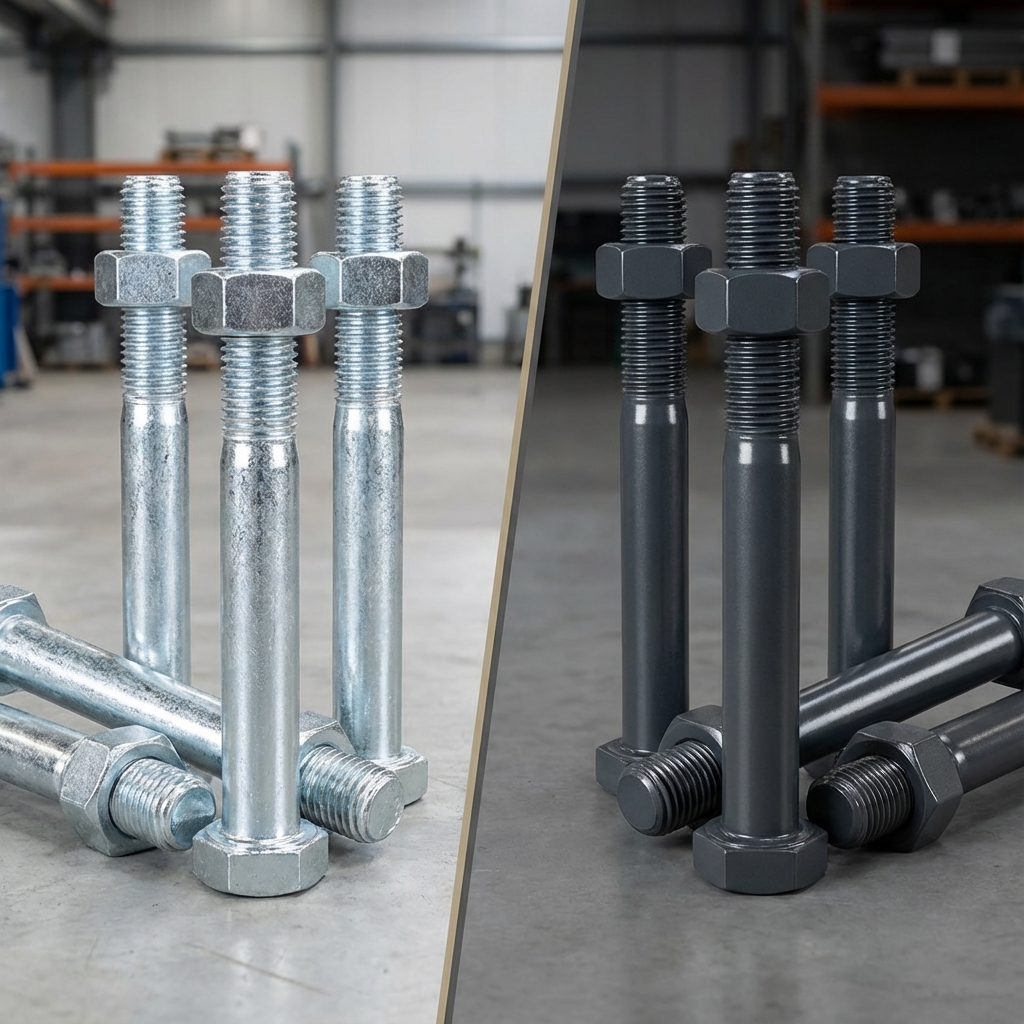
- Galvanizing: Adds 20-30% to base cost for corrosion protection
How Ayask Steel Can Help
With over 40 years of experience manufacturing precision foundation bolts for power plants, steel mills, and critical infrastructure, Ayask Steel provides expert guidance in selecting the optimal anchor solution for your specific application.
Our Services:
- Free engineering consultation to evaluate J-bolt vs. L-bolt requirements
- Custom fabrication of both types in sizes M12 to M100, lengths up to 6 meters
- All material grades including ASTM F1554, A193 B7, IS 2062, and stainless steel
- Complete surface treatment: hot-dip galvanizing, epoxy coating, custom finishes
- 100% dimensional inspection and material test certificates
- Fast turnaround: 3-4 weeks for standard orders, 5-6 weeks for custom configurations
- Delivered to your site with complete documentation for quality verification
Frequently Asked Questions
Which is stronger: J-bolts or L-bolts?
Are J-bolts cheaper than L-bolts?
Which bolt type is better for seismic zones?
Can I use J-bolts for heavy equipment foundations?
What embedment depth is required for each type?
Do J-bolts and L-bolts use the same materials?
Which bolt is easier to install?
Need Help Choosing Between J-Bolts and L-Bolts?
Contact Ayask Steel at +91 98338 33990 or email info@ayasksteel.com. Our engineering team can review your project specifications, load requirements, and foundation design to recommend the optimal anchor bolt solution—whether J-bolts, L-bolts, or alternative anchoring systems.
The choice between J-bolts and L-bolts isn't merely about geometry—it's about matching anchor performance to your specific structural requirements, load conditions, and installation constraints. By understanding the mechanical principles, advantages, and limitations of each type, you can make informed decisions that ensure structural integrity, optimize costs, and deliver reliable long-term performance for your critical industrial and infrastructure projects.